AI sales coaching software: 3 kinds, only 1 works mid-call
AI sales coaching software comes in three kinds: review, practice and live. What each one fixes, what it misses, and what to ask before you pay.
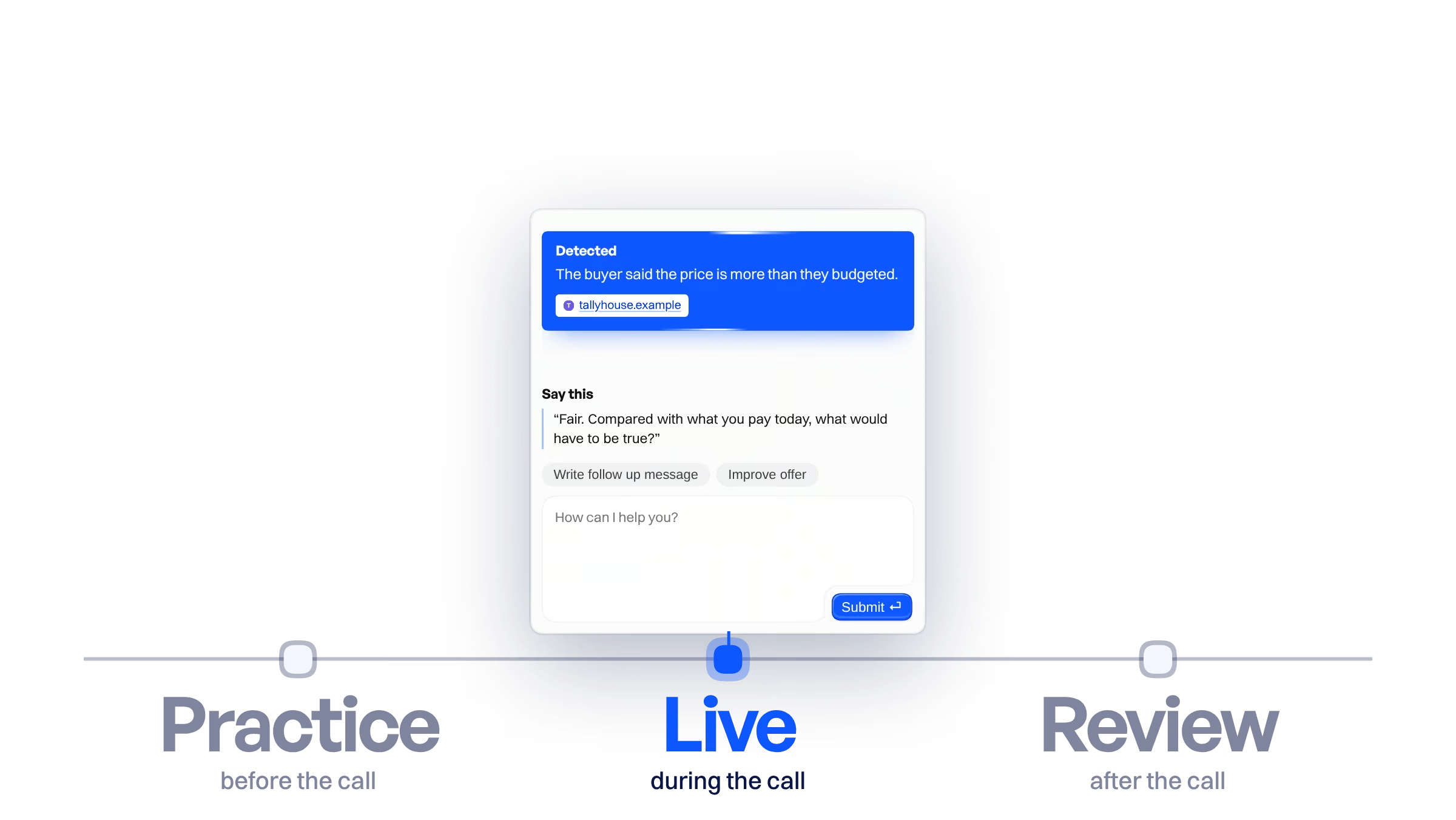
AI sales coaching software is three different products sharing one name. One reviews calls after they end. One lets a rep practise against an AI buyer. One helps while the call is actually happening. They fix different problems, so start with your problem, not with the category page.
What is AI sales coaching software?
Most vendors do one of the three well and put the other two on a slide. Here’s how they split.
| Kind | What it does | What it can’t do |
|---|---|---|
| Review | Reads the recorded call, scores it, shows a manager the patterns | Change what the rep said on the call it just reviewed |
| Practice | Lets a rep rehearse against an AI buyer and scores the run | Know your real account, or the call in front of the rep |
| Live | Shows a line during the call | Score a team, or build a call library |
Some names, so you can look them up. Gong is the best-known review tool, and our Gong alternatives post says where it fits. Second Nature’s site describes AI role-play training. Hyperbound sells practice with AI buyers, and its Perform page lists live call coaching too. That’s what their own pages said on 25 October 2026. I haven’t tested any of them, so read it as their description, not my verdict.
What should coaching software actually coach?
Most dashboards count what’s easy to count. Filler words, talk ratio, number of questions. Before I paid for any of that, I’d want proof that counting it matters. The only large set of call data we’ve found comes from Gong Labs. It’s Gong’s own customers, it’s correlation, and Gong sells the software. Still, it’s what exists.
| What gets counted | What Gong Labs found |
|---|---|
| Filler words | No link to win rate, cycle length or stage conversion, in nearly half a million calls (2017) |
| Talk ratio | Reps talked 57% of the time in won deals and 62% in lost ones, across 326K calls (2025) |
| Questions asked | Won deals averaged 15 to 16 a call, lost deals about 20 (2025) |
| Run-on after an objection | The average rep talked for 21.45 seconds straight (67,149 demos, 2018) |
Sources: Gong Labs on filler words, on the talk-to-listen ratio and questions and on handling objections.
So a tool that grades you on ums? Wrong thing to grade. A five-point gap in talk ratio isn’t a coaching program either, and Gong itself calls that gap not massive. The row that jumps out is the last one. Twenty seconds of talking right after a buyer pushes back is a habit you could actually change.
When does the coaching reach the rep?
This is the part I’d weigh most. Review coaching shows up days after the call, when the deal has already moved. Practice coaching shows up before the call, on a made-up buyer. Live coaching shows up in the sentence. Our post on post-call coaching arriving a week too late goes into why that gap stays open.
That doesn’t make the other two useless. A manager still needs to see patterns across a team, and a new rep still needs practice before a real buyer is on the line. But if the sentence after an objection is the problem, only the live kind can touch it.
Which kind should you start with?
Match it to where your deals actually go wrong. These are rules of thumb, my opinion and not a study.
New reps are burning real calls to learn. Start with practice. A rep should lose a made-up deal before they lose a real one.
Nobody can listen to enough calls. Start with review. A manager with forty reps can’t sit in on each of them, and a tool that surfaces the odd call is worth the money.
The rep knows the answer and still freezes when the buyer says it’s too expensive. Start with live. No amount of review fixes the three seconds in question.
You’ll probably end up with two. Don’t buy all three in the first month, though. You won’t know which one moved anything.
Can you start coaching this week without new software?
Partly. If you already record calls, take one transcript and paste it into ChatGPT or Claude with this. It won’t replace a tool, but it’ll show you what kind of coaching your team needs first.
Three coaching points from one call
Read this sales call transcript. Find the three moments where the seller had the best chance to do better. For each one give:
- The buyer’s words, quoted exactly.
- What the seller said next.
- One better line the seller could have said, in plain words.
Skip filler words and talk ratio. If the transcript is too short to judge, say so. Don’t guess.
Run it on five calls. If most of the moments sit right after an objection, that’s a live problem. If they’re spread across discovery and demos, a review tool will earn more.
What should you ask in a demo?
Questions for a coaching software demo
- Ask which of the three kinds it is, in one sentence
- Ask for the last insight it gave and what the rep did differently afterwards
- Ask what it counts, and whether that count is tied to a result
- Ask how long passes between the call and the coaching
- Ask what it stores: audio, video, a transcript or nothing
- Ask what it can’t do, and take a straight answer as a good sign
- Ask what happens to your data if you leave
Where does Axelize fit?
We build Axelize, and it’s the live kind only. Axelize writes your next sentence in your own voice while the buyer is still talking, from the account record and the product and objection library your team keeps. A manager changes what the whole team hears by editing that library, and the change lands on the next call. The median from the buyer’s last word to a line on screen is 1.4 seconds, measured end to end on our own calls.
And the limits. There are no team scorecards or call library, and no pipeline reports either. A manager sees the transcript and the suggestions for each meeting, and that’s it. If you need scorecards, you still need a review tool, and I’d run the two side by side. It works with Google Meet. Zoom and Microsoft Teams are on the roadmap. No bot joins and no audio or video is recorded, and the caption text stays on your account until you delete the meeting. There’s no free plan, but there’s a trial of 14 days or 5 calls with no card, and Solo is $29 a month after that.