How to find unresolved objections before a renewal call
Use the past year's call transcripts to find the objections a customer raised that nobody closed, before the renewal call. A prompt, a checklist and the tools.
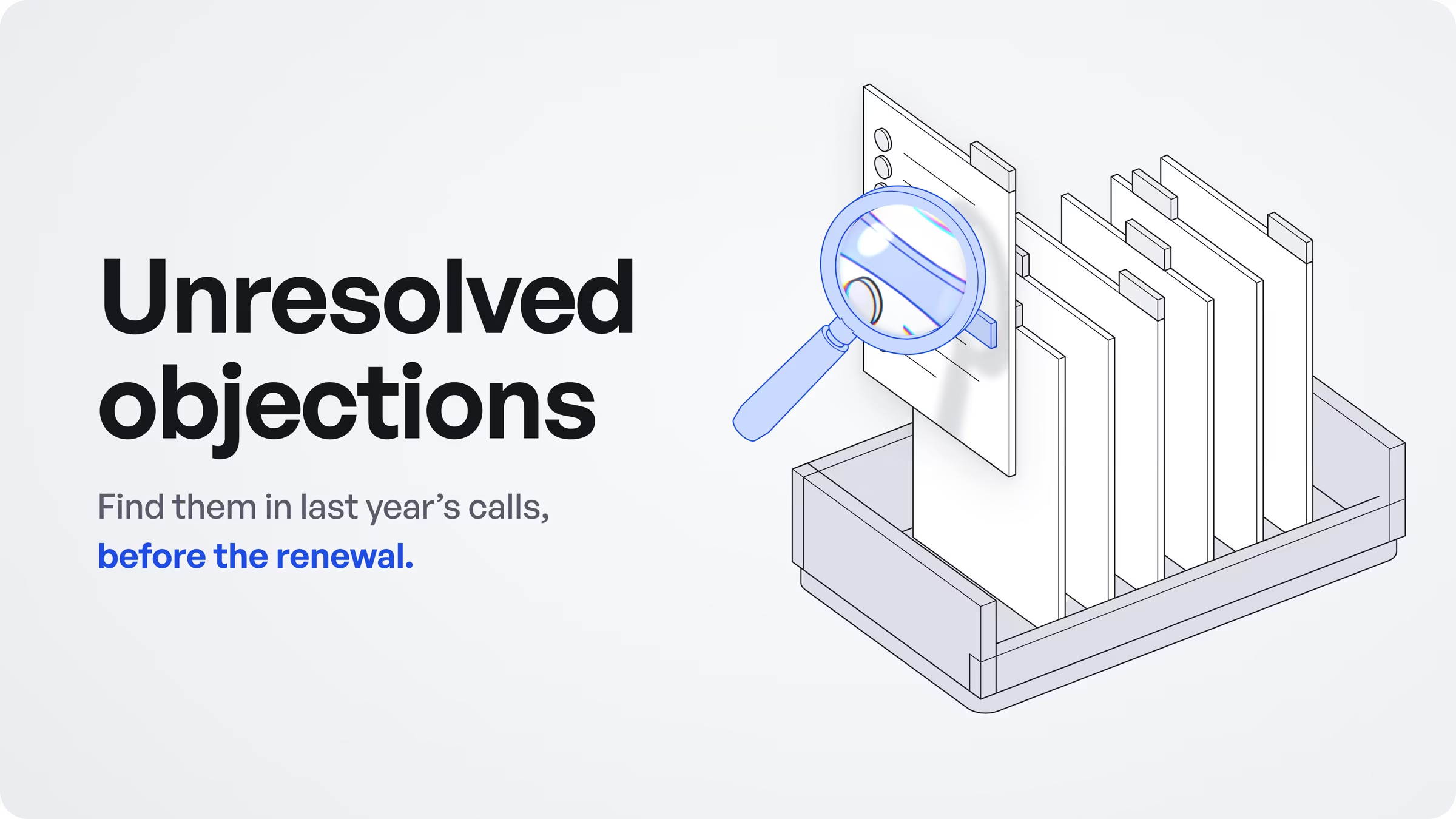
The renewal call starts and the customer says, “to be honest, we’ve been looking at a few other options.” Often, the reason was said out loud months ago. On a check-in, someone mentioned the reporting gap, everyone agreed to “revisit it next quarter”, and nobody did.
That reason is sitting in a transcript right now. You can find it in an afternoon, before the call, with transcripts you already have. Here’s how.
Why do unresolved objections come back at renewal?
Because the polite ones never get answered. “Let’s park that.” “We’ll work around it for now.” “Can you look into it and get back to us?” Each one sounds like agreement, so it goes into the notes as a to-do instead of being treated as an objection. Then the quarter moves on.
Twelve months later the customer hasn’t forgotten. They’ve just stopped asking. At renewal it comes back as a reason to look elsewhere, and now there’s a competitor’s quote attached.
You don’t need a new process for this. Read what was already said, all of it, before the renewal call instead of during it.
How do you find them in your call transcripts?
Five steps. Plan an afternoon for an account with ten to fifteen calls on record.
- Pull every transcript for the account from the contract term. Kickoff, check-ins, QBRs, support escalations. Your recorder, notetaker or meeting tool has them.
- Run each one through the prompt below, one call at a time. One long paste of twelve calls makes the model skim.
- Merge the lists into one table. Same concern raised twice? That’s one row, with both dates.
- Check each open row against what changed. Did the feature ship? Was the ticket closed? Did the person who raised it leave?
- Write your opener from the oldest open row that still matters.
Find what this customer raised and nobody closed
Read this customer call transcript. List every concern, objection or request the customer raised, including polite ones like “let’s revisit that”, “we’ll work around it” or “can you look into it”. For each one give:
- The customer’s exact words and who said it.
- The type: price, product gap, support, adoption, stakeholder change, competitor or timing.
- What happened next: answered on the call, deferred, or promised by us.
Then list only the deferred and promised items. If a line is unclear, say so. Don’t guess.
Step 4 is where most of the value is. A deferred item that has since been fixed is the best opener you have. A deferred item that’s still open is the thing you need an answer for before the call, not during it.
Which renewal platforms use call transcripts to flag objections?
Some do part of this for you. This is what each says on its own pages, read on 2 November 2026.
| Tool | What it reads | What it flags |
|---|---|---|
| Axelize (our pick) | The live call’s captions, plus every earlier meeting, note and file on the account | The objection and its type while the customer is talking, with a reply that uses the account’s history |
| Gong | Recorded customer calls and other touchpoints | Churn risk from “customer sentiment, ghosting, stakeholder changes, and more” (Gong) |
| Staircase AI, by Gainsight | Email, meetings and support channels | “Sentiment shifts, competitive mentions, and relationship changes” (Gainsight docs) |
| Vitally | Notes, conversations and meeting transcripts | Account summaries and risk, through Vitally AI (Vitally docs) |
| ChurnZero | Gong calls, through an integration | Gong’s AI summaries and action items in the meeting notes (Gong Collective) |
Notice what the platforms flag: risk. Sentiment, silence, a sponsor who left. That tells you an account is in trouble. It doesn’t hand you the customer’s own words from March, or tell you whether it was ever answered. The prompt above does, and it’s worth running even if you own one of these tools.
And Gong is a pricey way to get that score. It doesn’t publish a price, and the seat comes with a reported platform fee of $5,000 to $50,000 a year (our Axelize vs Gong page has the sources). We’d call that a lot of budget for a risk score you still have to read.
What do you say when the old objection comes back?
Say it before they do. Then show what changed, and ask what’s still open. Try it first.
What would you say?
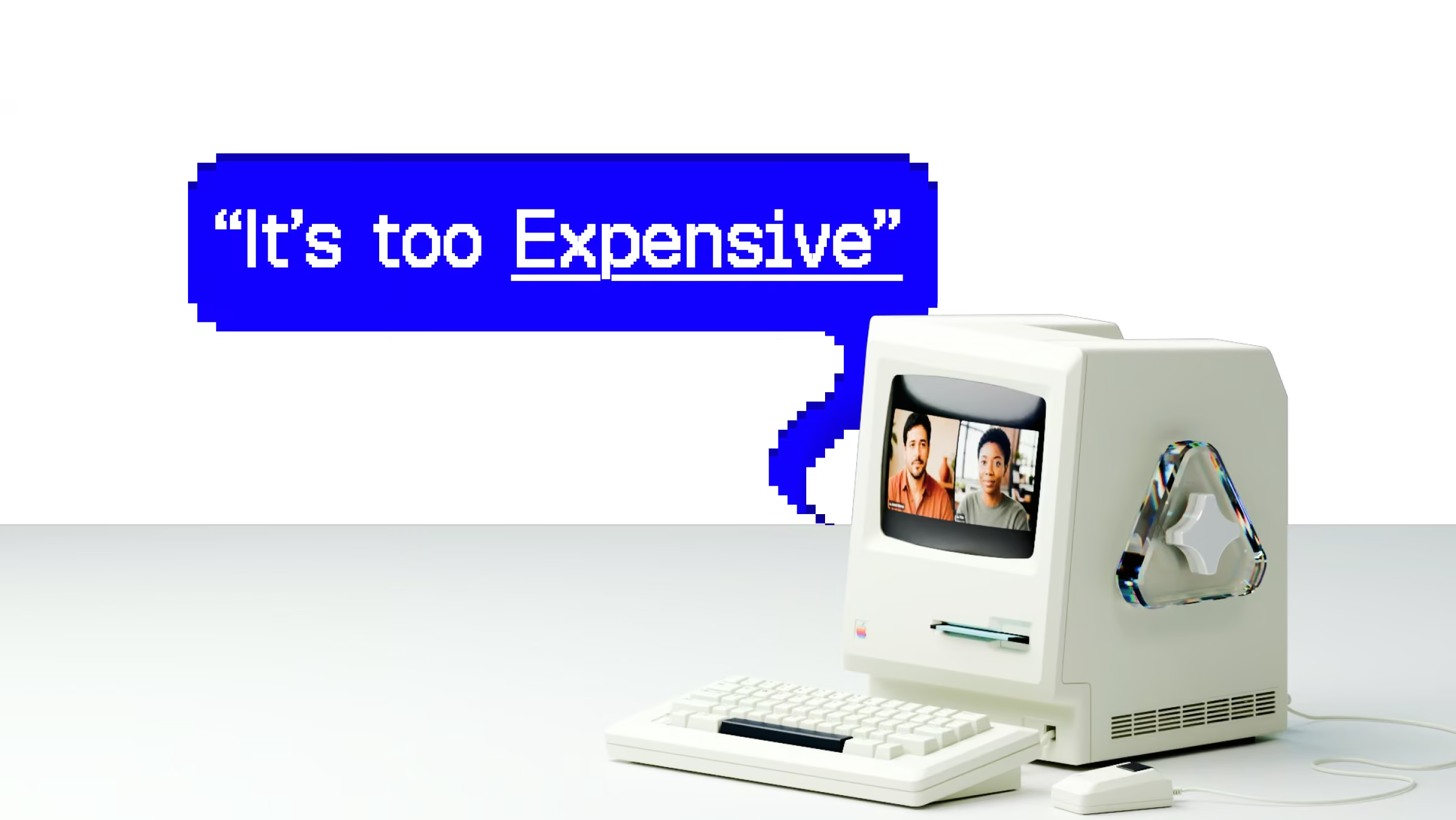
Buyer“To be honest, we've been looking at a few other options.”
Open a reply to see how it lands.
“I understand. If price is the issue, I can see what I can do on the renewal number.”
MissesIt guesses, and it guesses price. You've just offered a discount for a problem nobody named, and the real reason is still on the table.
“Totally fair. What would you need to see from us to stay?”
MissesIt hands the customer a blank page. They'll answer with the competitor's pitch, and now you're arguing against a demo you haven't seen.
“Thanks for saying it. In March you told us the reporting export was slowing your team down, and we said we'd come back to it. It shipped in June. Is that part of it, or is there something we haven't heard yet?”
LandsIt names the old objection in the customer's own terms, shows it was handled, and asks for the rest while there's still time to answer it.
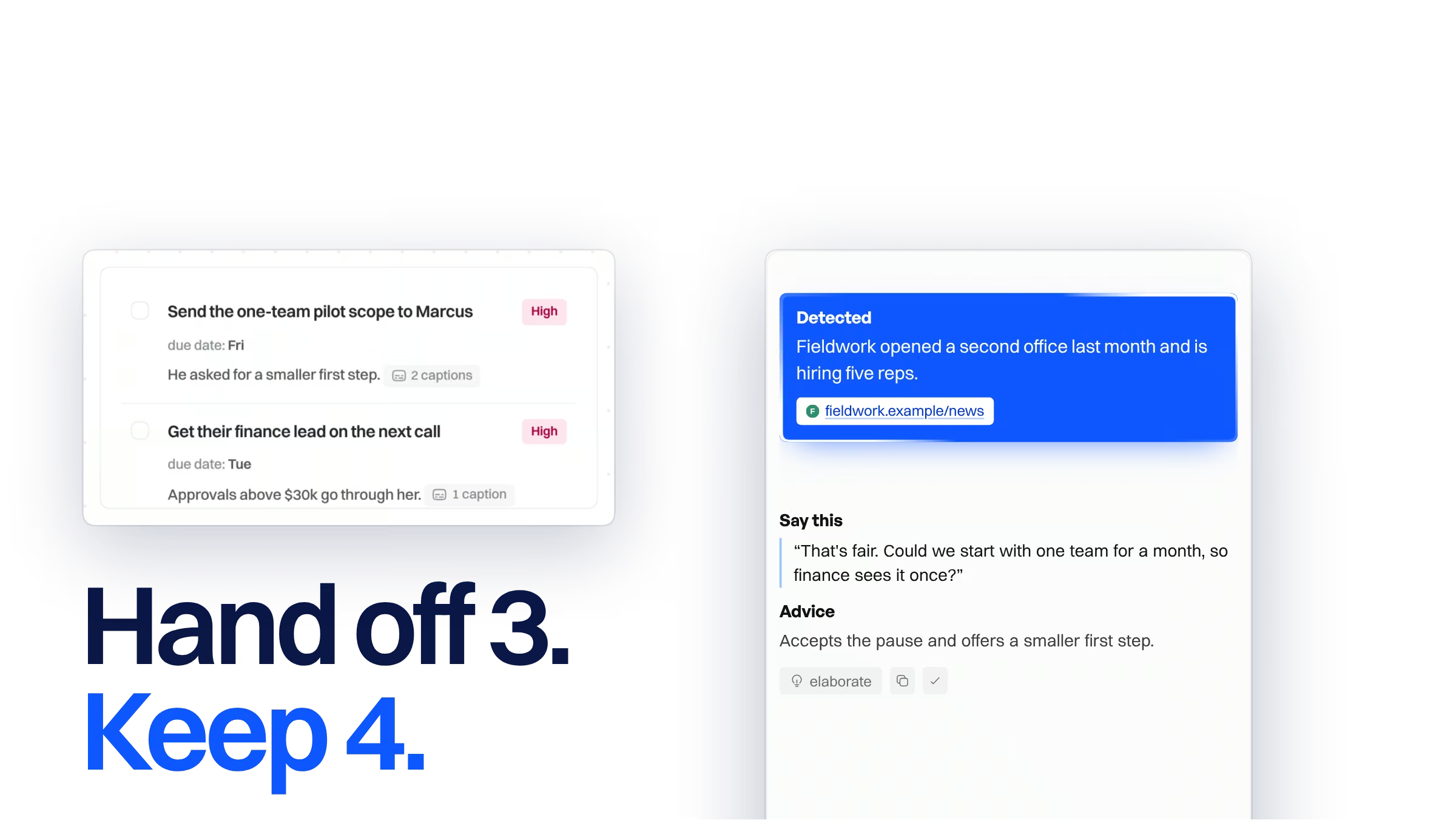
Axelize writes this kind of reply during your call.
The third reply only works if you know about March. That’s the whole case for doing the transcript work before the call.
A checklist for the 30 days before a renewal
30 days before the renewal call
- Pull every call transcript for the account from the contract term
- Run each one through the prompt and merge the open items
- Check each open item against releases, tickets and contacts who left
- Ask product or support for an answer on anything still open
- Write the opener from the oldest open item that still matters
- Confirm who’s on the renewal call, and who decides
- Put the open items in front of you during the call
Where Axelize fits
The last box is the one that slips. You did the reading, then the call starts and the customer says something you didn’t prepare for. Axelize reads the renewal call as it happens and flags the objection by type, price, timing, incumbent, authority or risk, while the customer is still talking. Then it writes your reply in your own words, from the account’s earlier meetings, notes and files.
Every meeting’s caption text stays on the account, so next year’s renewal prep starts with the transcripts already in one place. No bot joins and no audio or video is recorded. It works with Google Meet. Zoom and Microsoft Teams are on the roadmap.